
Paediatrics
Teaching and resources for your time with us in Paeds ED.
Welcome to the rotation
A 13-week program for both FACEM and FRACP trainees, combining online teaching, procedural skills training and shared sessions with Adult ED, PICU and the PEM Collaborative. Weekly teaching runs every Wednesday, 10am-2pm, mostly via Teams with some face-to-face sessions for skills and simulation at MCH Department of Paediatrics, Level 5 - check the timetable for this week's sessions and locations.

Photo: Nenad Stojković, CC BY 2.0

The PEM team puts on a fantastic education program that we're sure you will find beneficial. As per your EBA, all registrars and fellows are paid 5 hours per week to participate in teaching, and we expect an attendance rate of over 80% pro rata. The 80% calculation does not include when you cannot attend due to nights, annual leave, personal leave or alternative education arrangements:
- You are not expected to attend if you are rostered on nights on the Wednesday, just post nights, on annual leave or rostered to an AM shift on the floor. We can see this on the roster, and you do not need to email that you won't be attending.
- If you are away on personal/carers leave, please email the teaching consultants to advise them of this - easiest way is to reply to the consultant that sent the reminder email.
- Some trainees may opt to attend alternate teaching, such as Fellowship stream or if attending a course/conference - please discuss this with your DEMT and the teaching team so we can mark your attendance accordingly.
Less than 80% attendance will be reviewed and reflected in your end of term assessment, specifically in regards to your professionalism.
Teaching pearls
- Set goals early. Identify what you want out of the term - septic work-up, fracture manipulation, procedural sedation - so you can meet your DOPS/WBA requirements early.
- Take up ad hoc learning. Senior clinicians on the floor often have expertise in simulation, research, examining (ACEM and RACP), or education - in-situ sim, airway huddles and skills days are all worth jumping into.
Skills and sim sessions
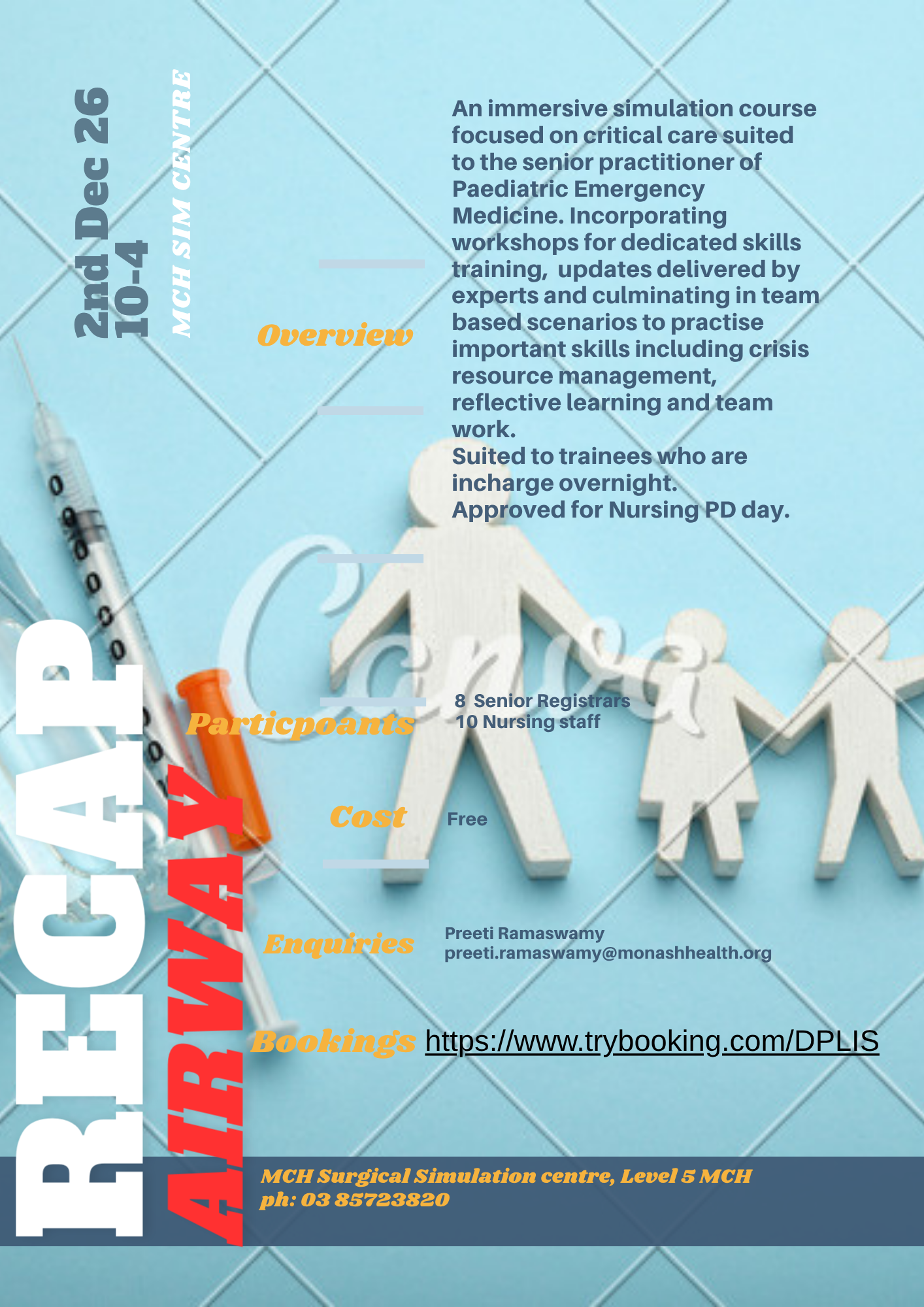
Four or five weeks of the term are in-person education sessions where we focus on hands-on skills and simulation training. We cover things such as critical care procedures and mandatory skills as a building block for the term's simulation-based learning. Pre-reading and videos are provided ahead of each session to make the day more hands-on - trainees have reported using these skills successfully on real patients soon after.
Outside of the regular Wednesday teaching there are many more options for simulation teaching - see Teaching → Simulation for the Moorabbin Simulation Centre, ACE/TRAC courses and MMC ED interdisciplinary SIM, all of which paediatric trainees are welcome to join.
PEM Stream
A new addition in 2026, some weeks we run a concurrent PEM Stream education session aimed at PEM advanced trainees, to further both PEM-specific skills and the approach to transitioning to consultancy. This stream is aimed at the fellows, those enrolled in PEM (FRACP or ACEM), and those trainees who have been in paediatric ED for some time and are ready to expand on their knowledge. The teaching team will guide which stream will meet your learning goals best - please ask us if you have queries on this.
Registrar presentations
Towards the end of term we love to hear from our registrar team as part of teaching.
If allocated to give a presentation, each registrar gets 20 minutes - 15 for the presentation, 5 for feedback and questions. It's meant to be a learning opportunity, not a stressful event; a recent relevant journal article works just as well as a case presentation if you'd prefer. Swap dates with a colleague if yours doesn't work, and let the team know.
A cheat sheet from past presenters:
- Pick something you actually care about and focus on what you learnt - if you didn't know it, chances are others don't either, and it starts a conversation.
- Narrow it down: one specific angle on a case (investigations, management, differentials, the literature) rather than trying to cover everything.
- A slide deck helps keep a 15-minute solo talk engaging.
- Stuck for a topic? Contact Bev, Tess or Preeti.
- Practise at least once beforehand.
- Your colleagues are genuinely interested in what you have to say - believe it.
Resources

Procedural sedation
RCH's procedural sedation guideline. →
Fracture management
Paediatric fracture patterns differ from adult ones - easy to over-treat or miss a pattern. RCH's fracture guidelines are recommended reading. →

ECG guidelines
Starship's paediatric ECG guideline. →

PEMedu
External paediatric emergency medicine education resource. →

Don't Forget The Bubbles
External paediatric emergency medicine education resource. →
RCH Clinical Practice Guidelines
Royal Children's Hospital's clinical guideline library. →
From the Journals
Mike South's paediatrics journal-review blog. →
Paediatric radiology cases
A collection of plain radiology cases in paediatric emergency medicine. →
Education team
Reach out to the Paediatric ED education team with questions or suggestions:
- Dr Preeti Ramaswamy - Preeti.Ramaswamy@monashhealth.org
- Dr Beverley Thompson - Beverley.Thompson@monashhealth.org
- Dr Adnan Bilgrami - Adnan.Bilgrami@monashhealth.org